New paper alert!
February 9, 2026
State of Global Environmental Governance 2025
February 20, 2026
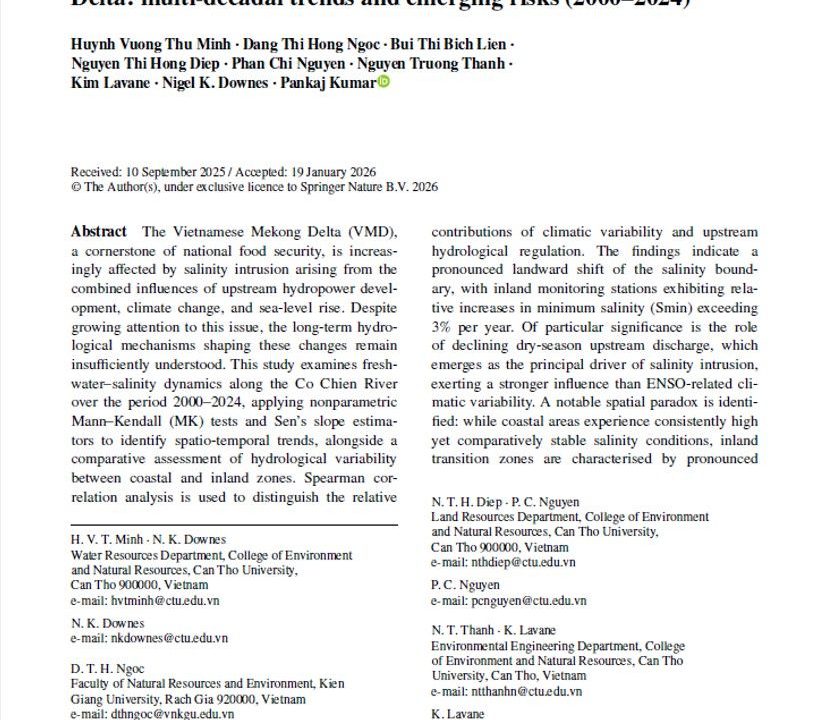
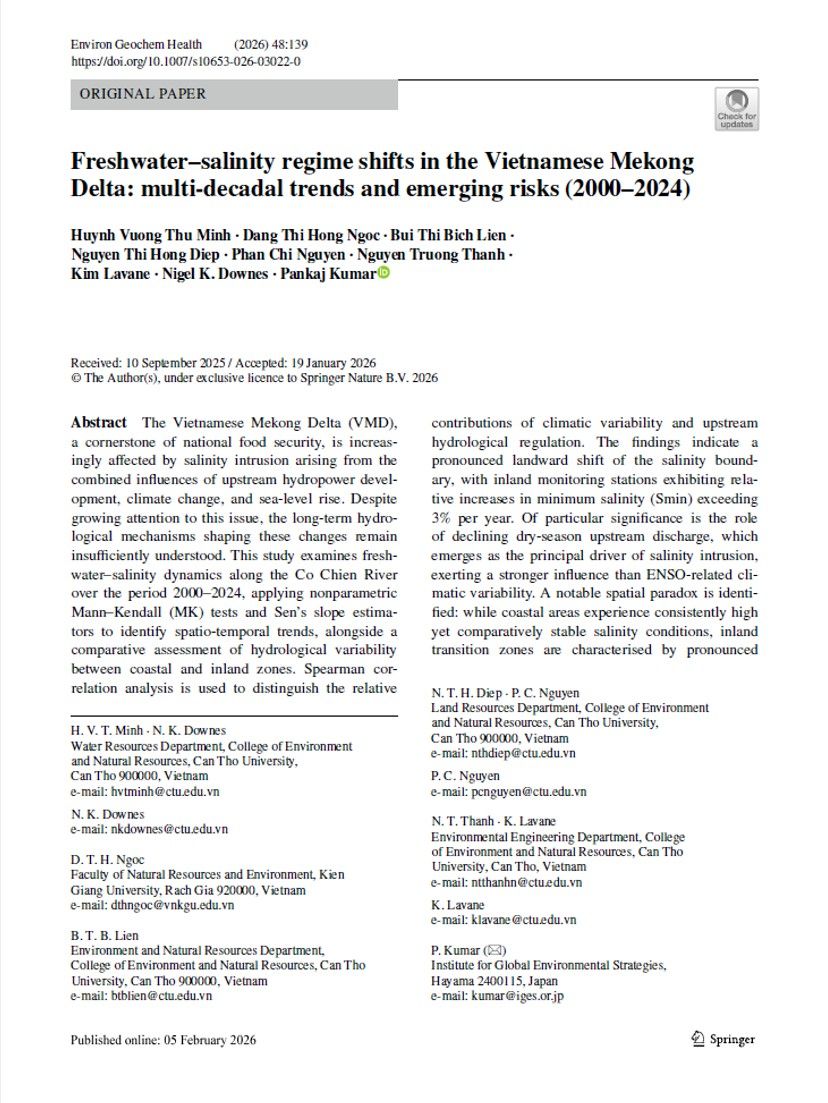
The Vietnamese Mekong Delta (VMD), a cornerstone of national food security, is increasingly affected by salinity intrusion arising from the combined influences of upstream hydropower development, climate change, and sea-level rise. Despite growing attention to this issue, the long-term hydrological mechanisms shaping these changes remain insufficiently understood. This study examines freshwater–salinity dynamics along the Co Chien River over the period 2000–2024, applying nonparametric Mann–Kendall (MK) tests and Sen’s slope estimators to identify spatio-temporal trends, alongside a comparative assessment of hydrological variability between coastal and inland zones. Spearman correlation analysis is used to distinguish the relative contributions of climatic variability and upstream hydrological regulation. The findings indicate a pronounced landward shift of the salinity boundary, with inland monitoring stations exhibiting relative increases in minimum salinity (Smin) exceeding 3% per year. Of particular significance is the role of declining dry-season upstream discharge, which emerges as the principal driver of salinity intrusion, exerting a stronger influence than ENSO-related climatic variability. A notable spatial paradox is identified: while coastal areas experience consistently high yet comparatively stable salinity conditions, inland transition zones are characterised by pronounced hydrological instability. These patterns point to the limitations of predominantly localised engineering responses and underline the need for more anticipatory, inter-regional approaches to water governance. Integrating upstream discharge thresholds into early-warning systems offers a pathway towards enhancing the resilience of livelihoods in the delta’s most vulnerable transitional landscapes.
Read more HERE